MYOB Sync for Amazon: Setup and Troubleshooting
By the MySync team · Updated 17 November 2026
Follow this guide to configure and check your Amazon connection. Review the current app and provider permissions for the flows you choose.
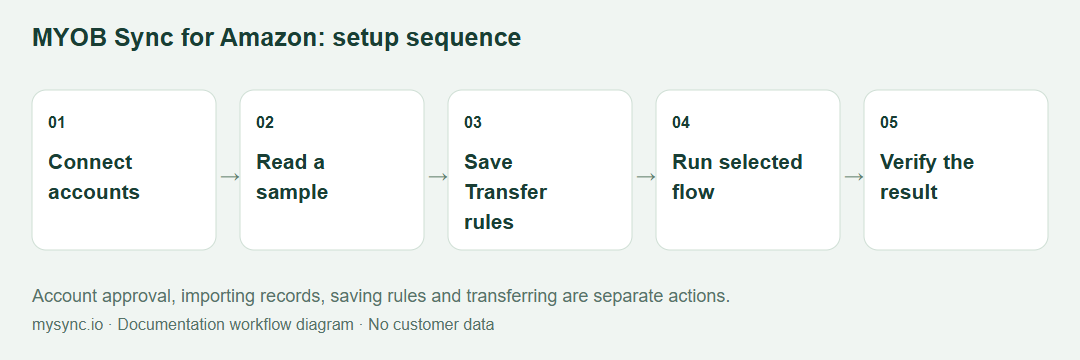
Prepare the account and sample
This guide covers the practical MySync workflow for Amazon. The Amazon product page describes features and business use cases separately.
- An Amazon seller participating in the Australian marketplace.
- A MYOB company file with compatible sales, inventory and banking capabilities.
- Seller SKU mappings and an agreed distinction between merchant-fulfilled and Amazon-fulfilled stock.
Choose a small source sample with an expected destination result. Use an authorised company file and keep automatic flows off while checking the first run. Your MySync subscription and your provider’s own subscription are separate.
Sign in and connect the accounts
- Open MYOB Sync. Register if needed, verify the account and choose Amazon. Existing users return to their saved app.
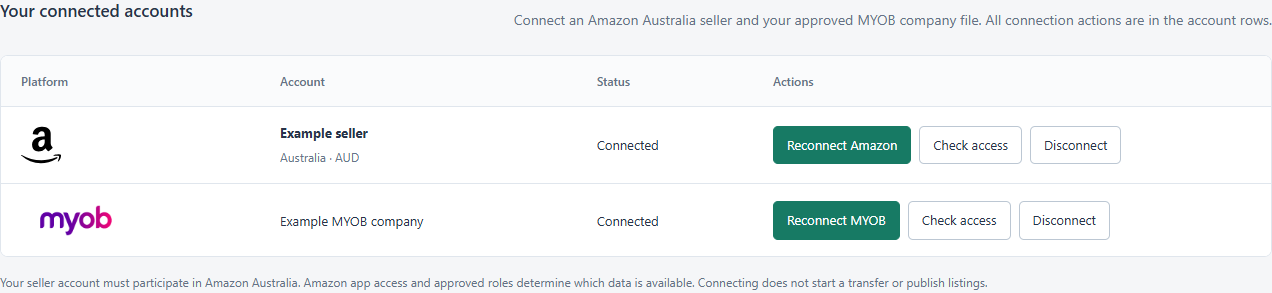
- Open Connections. Read the platform account name and the MYOB company-file name before continuing.
- Open the Amazon integration through the MYOB Sync portal and follow the seller-authorisation option provided in Connections. Use the Amazon Australia seller account you intend to link and connect MYOB separately. Customers do not enter developer client secrets into the app.
- Use the action in the relevant account row. OAuth approvals open on the provider’s own site. Where a credential form is needed, enter it only inside the app.
- After approval, return to Connections and confirm the displayed account and status. Reconnect when access needs renewing; do not copy an expired authorisation URL.
Connecting grants access but does not enable every transfer. Start with a read-only import and deliberately save the flows you want.
Confirm marketplace and company file
Check that the seller participates in Australia and that the approved MYOB file is the intended destination. Use a default Amazon customer card unless an explicitly authorised workflow requires buyer personal information.
Match seller SKUs
Import source records and map seller SKUs to MYOB item numbers. Distinguish merchant-fulfilled listings from FBA and mixed fulfilment listings; do not use MYOB stock to overwrite Amazon-managed inventory.
Configure order rules
Choose the sales document type, tax mappings, eligible order states and fallback item if appropriate. Review shipping, charges and total reconciliation before enabling exports.
Review financial release evidence
For payments, fees and disbursements, check whether Amazon has released sufficient financial evidence. Deferred balances, reserves and unexplained adjustments are not ready for automatic posting.
Prepare and review listing drafts
For catalogue work, supply images, required attributes and the intended offer data. Run validation and resolve category-specific issues before an explicit submission. Automatic runs prepare drafts rather than publish new listings.
Check the key fields
Use this reference alongside Transfer rules. Controls vary by platform and entitlement; review the labels shown in your app rather than assuming another platform’s mappings apply.
| Field or decision | What to check |
|---|---|
| MYOB company | The approved destination file shown beside the MYOB logo in Connections. |
| SKU / item identity | Match the sellable source SKU or variant with the intended MYOB item; investigate ambiguous matches. |
| Customer strategy | Use the supported individual-customer or default-card strategy for the intended sale. |
| Tax and freight | Compare the source lines, tax codes, shipping and total before exporting the first sales document. |
| Inventory location | Select the location or warehouse supported by this platform and the intended stock source. |
| Run and schedule | Enable selected flows and save. A schedule must contain an actual timing selection; saving does not run a manual export. |
Run, inspect and repeat a small transfer
- Read the source records with the app’s import or preview action. Check the import count and a known source reference.
- Open Transfer rules, enable only the flows required by the sample and save. Review required fields and any highlighted sections.
- Start the relevant manual sync or transfer using the app’s job controls. Imports, previews, saved settings and completed transfers are different actions.
- Compare the actual MYOB document, quantity or financial entry against the expected source result. Review source currency, tax, freight, fees and receiving accounts where applicable.
- Run the same unchanged sample again. Existing completed work should be recognised. Investigate any uncertain result before repeating a financial write.
- When satisfied, select the required schedule and enabled flows. Review the time zone shown in the app and inspect the first scheduled result.
Track exported, unchanged, skipped, rejected and review outcomes separately. A successful run can still contain excluded or unsupported source records.
Resolve a failed or incomplete result
A stock update or settlement remains in review
Check merchant-fulfilled eligibility, SKU links and released financial evidence. Do not force FBA stock changes or turn deferred financial balances into guessed payments.
MYOB approval fails
Restart Connect MYOB from the app and approve the intended file. If MYOB reports a redirect-URI mismatch, send support the error text: that is an app-registration configuration problem, not a reason to share your MYOB password.
An automatic run never starts
Confirm the flow is enabled, required fields are saved, a real schedule is selected and the current plan includes it. A toggle without a timing selection cannot define when a job should run.
A transfer timed out or may already exist
Read the record note and inspect the destination first. Keep the original reference and run time. Do not create a manual duplicate while an outcome is uncertain. Use the app’s supported retry or review action once the actual result is known.
Manage billing and connection access
See the Amazon app for the plan options and supported flows offered to your account. Catalogue, inventory, sales and financial features have different requirements; choose the scope your business needs.
Use Account & help or the app’s account screen to inspect current entitlements and billing controls. Disconnecting a provider is separate from cancelling a subscription. Use the available billing controls to manage renewal; ask support if you cannot access them.
Disconnect removes the credentials held for that link. Revoke the provider’s app grant or API key when you also want to remove access at the source. Review mappings and sample results again after replacing a company file or destination account.
Gather useful support evidence
Send support@mysync.io the app name, affected store or account, source record reference, run time and time zone, action attempted and exact error message. Include a provider request ID when shown. Keep passwords, client secrets, access tokens and payment-card data out of the message.
Related references: MYOB Sync troubleshooting, MYOB errors and logs and activity.
Choose another MYOB Sync guide
- Neto setup
- Shopify setup
- WooCommerce setup
- BigCommerce setup
- Squarespace setup
- Klaviyo setup
- Mailchimp setup
- Stripe setup
- PayPal setup
- eBay setup
- Square setup
Amazon integration features · Workflow planning guide · All help guides